M=4,
containing all the letters of the alphabet,
unique? Explain.
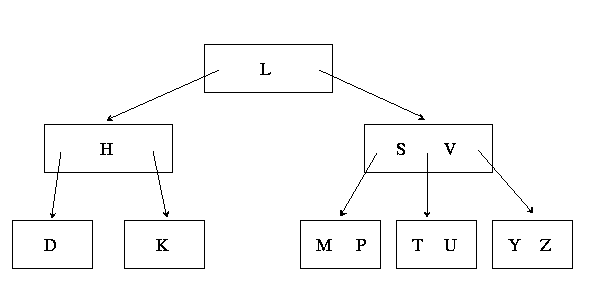
M=3 is given below.
Insert a record with key N,
making sure to show the evolution of the tree as the B-tree insertion
algorithm proceeds.
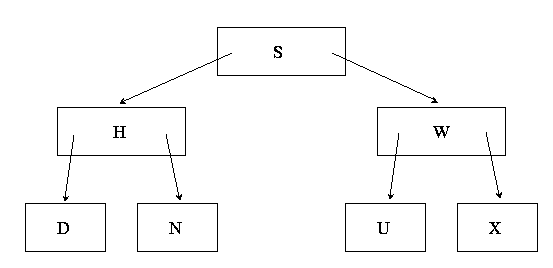
M=3 is given below. Delete the
record with key N, making sure to show the evolution of
the tree as the B-tree deletion algorithm proceeds.
M) of a B-tree:
- block size = 1024 bytes
- pointer size = 4 bytes
- key size = 8 bytes
M=3 allows nodes to have as many as
three children. Why is a B-tree of order M=2 not
necessarily a binary search tree?
M=3, consisting of
three levels of completely full index nodes,
how many disk accesses would it take to perform the
following tasks? Fill in the table and show your calculations, below.
| task | B-tree | B+ tree | ||
|---|---|---|---|---|
| at most | at least | at most | at least | |
| locate an arbitrary record | ||||
| locate sequentially next record | ||||
M=3 by inserting the
following keys into an initially empty tree:
A, B, C, D, E, F, G, H.
Show the tree at each stage.
b) Can a tree of lower height, also of M=3 and containing
the same keys as in part (a) be constructed? If so, show such a tree,
and if not, explain why not.
c) If we now added a record with key I to the tree of part (a), would your answer to part (b) change? Justify your answer numerically.
d) Delete the record with key B from the tree of part (a).
Show the tree at each stage.